Showing posts with label MTH-230. Show all posts
Showing posts with label MTH-230. Show all posts
Thursday, December 6, 2012

Monday, December 3, 2012


Tuesday, October 23, 2012

Tuesday, October 16, 2012
HW for Diff Eq's Assigned 10/15/12
We moved on to differential operators (Section 4.5) and the annihilator method of undetermined coefficients (Section 4.6). The homework for these sections is as follows:
Section 4.5: #1, 5, 9, 11, 21-31 odd, 35, 37, 39
Section 4.6 #1-21 odd, 33, 35, 37
We didn't spend much class time on it, but in Chapter 5 covers applications of 2nd order linear DE's as solved by the methods of Chapter 4. So far, the assignment is as follows:
Section 5.1: #1, 15-18 all
Section 5.2 #1, 15-17 all
Section 5.3 #2, 3
These all cover simple harmonic motion (5.1: free undamped, 5.2: free damped, and 5.3: forced). Section 5.4 will cover other applications of linear 2nd order DE's with constant coefficients, mainly LRC circuits. There will be problems assigned from this section later.
Tuesday, September 11, 2012
MTH-230 Differential Equations Homework

Friday, July 27, 2012


Wednesday, July 25, 2012

Sunday, July 22, 2012


Monday, July 16, 2012

Saturday, June 30, 2012


Friday, June 29, 2012
Diff Eq's: Solutions to Problems in Section 4.4
Here are solutions to problems #1-17 odd in Section 4.4 where we solve non-homogeneous linear DEs with constant coefficients, where the forcing functions are sums and products of polynomials, exponentials, and sine and cosine. The last few involve a great deal of bookkeeping to determine the coefficients.
Note that in #15, the forcing function has the same frequency as the natural frequency gotten from solving for the complementary solution. Therefore, you might have guessed the particular solution to be of the form x(A cos ωx + B sin ωx), but if you tried it, you found it didn't work. It would have worked if the forcing function weren't already multiplied by x. Since it is, we must instead propose a particular function with both sine and cosine multiplied by 2nd order polynomials with undetermined coefficients. (Actually, you could always err on the side of caution and propose higher order polynomial multiples. That would be a lot of useless busy-work, though, in cases where we can be sure of the order of the polynomial in the solution.)

Note that in #15, the forcing function has the same frequency as the natural frequency gotten from solving for the complementary solution. Therefore, you might have guessed the particular solution to be of the form x(A cos ωx + B sin ωx), but if you tried it, you found it didn't work. It would have worked if the forcing function weren't already multiplied by x. Since it is, we must instead propose a particular function with both sine and cosine multiplied by 2nd order polynomials with undetermined coefficients. (Actually, you could always err on the side of caution and propose higher order polynomial multiples. That would be a lot of useless busy-work, though, in cases where we can be sure of the order of the polynomial in the solution.)

Sunday, June 24, 2012
Diff Eq's: Solutions to Problems in Section 4.3
Here are solutions written out in detail for the Section 4.3 HW. I meant to do problem 27 but did problem 29 twice instead.


Tuesday, June 19, 2012
Diff Eq's: Solutions to Problems in Sections 4.1 and 4.2
Here are detailed solutions to the homework problems assigned for 4.1 and 4.2. I will post solutions for 4.3 and 5.1, 2 & 4 as soon as I can get to it.


Friday, June 8, 2012
MTH-230 Homework, Sections 4.1-3
Reminder: Test 1 is open in the Testing Center in Mt. Laurel and you have until Thursday, June 14 to go take the test.
Section 4.1 #1-9 (odd), 6, 15-21 (odd), 37, 41


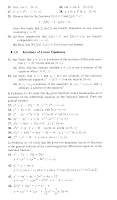
Section 4.1 #1-9 (odd), 6, 15-21 (odd), 37, 41


Sunday, June 3, 2012

Friday, June 1, 2012

Tuesday, May 22, 2012


Monday, May 21, 2012
MTH-230 Syllabus
MTH-230 Differential Equations Instructor: Edward Bailey (ebailey@bcc.edu)
MW 09:00AM - 11:45AM, TEC 210 http://mathematikoi.blogspot.com
This first course in Differential Equations is equivalent to those offered at 4-year institutions. In the expectation that most, if not all, students enrolled in this course will be pursuing degrees in engineering, the topics covered will be geared toward engineering applications. This course should be readily transferrable to such institutions. Should any difficulty arise in securing transfer credit, the student should contact both the instructor and the BCC transfer coordinator.
Course Outline
Unit I: Basic definitions and principles.
1) Basic definitions
2) First order ordinary Differential Equations (DE’s)
a) Existence (and uniqueness) theorem
b) Solution methods
i) Separable variables
ii) Homogeneous DE’s
iii) Exact DE’s
iv) Solution by integrating factors of linear 1st order DE’s
v) Bernoulli Equation (optional)
Unit II: Second order linear DE’s
1) Preliminary theory
a) Initial value and boundary value problems
b) Linear dependence and independence
c) Solutions of linear equations
2) Variation of parameters
3) Constructing a second solution of a 2nd order homogeneous linear DE from a known solution
4) Homogeneous linear DE’s with constant coefficients
5) Undetermined coefficients and differential operators
6) Physical applications: mechanical vibration and analogous systems
Unit III: Laplace Transform and systems of DE’s
1) Laplace transform
2) Inverse transform
3) Translation theorems and derivatives of a transform
4) Transforms of derivatives, integrals, and periodic functions
5) Applications
6) Dirac delta function (optional)
7) Laplace transform method of solving systems of linear DE’s
Prerequisite: MTH-220 Calculus III
Text: Zill, D. A First Course in Differential Equations, The Classic Fifth Edition. Brooks/Cole, 2001.
Grading: There will be three exams given, one corresponding to each unit. Where x is the average of your test grades, x ≥ 90% earns an A, x ≥ 80% earns a B, x ≥ 70% earns a C, and x ≥ 60% earns a D. Averages of at least 85% or 75% earn a B+ or C+, respectively.
Homework: It will be assigned at each class meeting and posted on the blog (see above). It will not be collected or graded. Bring it to class and be prepared to discuss it. Since you made it through Calculus III, you should be well aware that diligence in doing homework assignments is the key to success.
Calculators: Use of calculators on tests is neither necessary nor permitted.
Office Hours: I do not have an office. However, I can meet with students on campus on Mondays and Wednesdays after class. Email me and I’ll try to get back to you promptly. Email is the way for you to contact me outside of class. Use your BCC email account so your email is not mistaken for spam. Check my blog for announcements (see above).
MW 09:00AM - 11:45AM, TEC 210 http://mathematikoi.blogspot.com
This first course in Differential Equations is equivalent to those offered at 4-year institutions. In the expectation that most, if not all, students enrolled in this course will be pursuing degrees in engineering, the topics covered will be geared toward engineering applications. This course should be readily transferrable to such institutions. Should any difficulty arise in securing transfer credit, the student should contact both the instructor and the BCC transfer coordinator.
Course Outline
Unit I: Basic definitions and principles.
1) Basic definitions
2) First order ordinary Differential Equations (DE’s)
a) Existence (and uniqueness) theorem
b) Solution methods
i) Separable variables
ii) Homogeneous DE’s
iii) Exact DE’s
iv) Solution by integrating factors of linear 1st order DE’s
v) Bernoulli Equation (optional)
Unit II: Second order linear DE’s
1) Preliminary theory
a) Initial value and boundary value problems
b) Linear dependence and independence
c) Solutions of linear equations
2) Variation of parameters
3) Constructing a second solution of a 2nd order homogeneous linear DE from a known solution
4) Homogeneous linear DE’s with constant coefficients
5) Undetermined coefficients and differential operators
6) Physical applications: mechanical vibration and analogous systems
Unit III: Laplace Transform and systems of DE’s
1) Laplace transform
2) Inverse transform
3) Translation theorems and derivatives of a transform
4) Transforms of derivatives, integrals, and periodic functions
5) Applications
6) Dirac delta function (optional)
7) Laplace transform method of solving systems of linear DE’s
Prerequisite: MTH-220 Calculus III
Text: Zill, D. A First Course in Differential Equations, The Classic Fifth Edition. Brooks/Cole, 2001.
Grading: There will be three exams given, one corresponding to each unit. Where x is the average of your test grades, x ≥ 90% earns an A, x ≥ 80% earns a B, x ≥ 70% earns a C, and x ≥ 60% earns a D. Averages of at least 85% or 75% earn a B+ or C+, respectively.
Homework: It will be assigned at each class meeting and posted on the blog (see above). It will not be collected or graded. Bring it to class and be prepared to discuss it. Since you made it through Calculus III, you should be well aware that diligence in doing homework assignments is the key to success.
Calculators: Use of calculators on tests is neither necessary nor permitted.
Office Hours: I do not have an office. However, I can meet with students on campus on Mondays and Wednesdays after class. Email me and I’ll try to get back to you promptly. Email is the way for you to contact me outside of class. Use your BCC email account so your email is not mistaken for spam. Check my blog for announcements (see above).
Subscribe to:
Comments (Atom)